
This question was brought into focus by Ralph Wassermann, Director of Design and Development for Hydraulic/Valve Technology/Automotive, during his technical presentation at the International Fluid Power Conference (IFK) in Aachen from March 9–11, 2026.
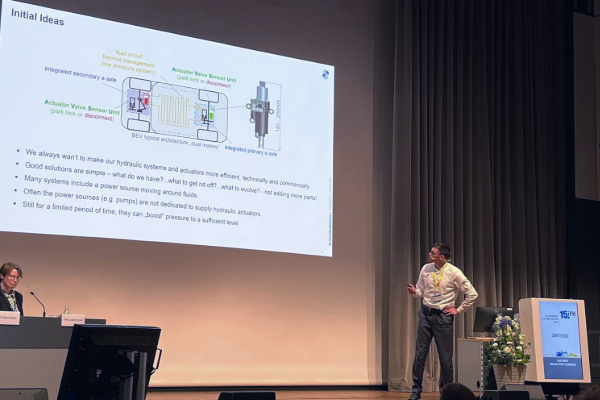
Photo: Expert Ralph Wassermann presenting live at the IFK.
In his presentation titled „High efficient Hydraulic Actuator Valve Sensor Unit without dedicated hydraulic supply“ Mr. Wassermann demonstrated how innovative concepts in electrohydraulics can significantly improve the efficiency and future viability of modern mechatronic systems—and the opportunities this creates, particularly for mechatronic applications in the automotive sector. With this, Ralph Wassermann contributed valuable technical insights to one of the leading international conferences in fluid power technology.
Our participation at the IFK underlines our commitment to actively driving technological innovation and setting new impulses in the industry.
In a follow-up expert interview with MSM, Mr. Wassermann provided further insights into his presentation at IFK 2026:
Mr. Wassermann, what was the key question and the initial idea?
Ralph Wassermann: "We wan‘t to make our hydraulic systems and actuators more efficient, technically and commercially.
Good solutions are simple: What do we have? What to get rid off? What to evolve? And not by adding additional components. Many systems already include a power source moving around fluids. Often the power sources (e.g. pumps) are not dedicated to supply hydraulic actuators. Still for a limited period of time, they can „boost“ pressure to a sufficient level.
What does this approach mean in concrete terms for the benefits and objectives of our customers?
Ralph Wassermann: "Our overarching goal can be summarized very clearly: to become more efficient, more compact, and more scalable.
In concrete terms, this means developing solutions that are more powerful, more compact, and more robust than comparable electric driven actuators. At the same time, we significantly reduce system complexity compared to conventional hydraulic systems, which has a direct positive impact on integration, operation, and maintenance.
Another key aspect is scalability. Our approach is not limited to a single application; instead, it is intentionally designed to be transferable across different markets and use cases — ranging from automotive and trucks to aerospace, defense, and industrial applications.
At the same time, we never lose sight of the economic perspective. Resource saving and cost efficiency are crucial factors for us, both during development and throughout the entire lifecycle of the system.
Last but not least, safety plays a central role. By continuously monitoring both the actuator position and the condition of the mechanical locking system, we ensure maximum transparency and reliability. At the same time, we make sure that the solution complies with the requirements of functional safety according to ISO 26262.
In short: we provide our customers with a technically superior, economically attractive, and future-ready solution that can be flexibly adapted to a wide range of requirements."
What solution did you and your team develop to achieve these diverse objectives?
Ralph Wassermann: “We have developed the High-efficient Hydraulic Actuator Valve Sensor Unit (HAVSU) without dedicated hydraulic supply and have already successfully implemented it in real-world applications.”
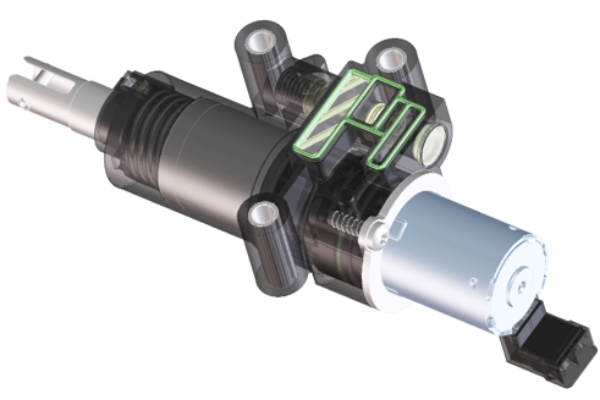
Photo: The High-Efficient Hydraulic Actuator Valve Sensor Unit (HAVSU) without a dedicated hydraulic supply.
How is this practical application reflected in real-world use cases?
Ralph Wassermann: "Our HAVSU demonstrates its strengths, for example, as actuator in park-lock-application in ZF’s next-generation e-drive ‘SELECT’. Through innovations and a sophisticated system optimization strategy, this e-drive achieves a maximum efficiency of 96.3 percent. (Source: ZF)
For us, proven practical relevance also means that — in line with MSM’s quality standards and given the high technical and functional requirements — the HAVSU underwent comprehensive validation and intensive testing prior to its implementation."
You mentioned intensive testing and thorough validation. Which performance data and test results demonstrate the performance and reliability of the HAVSU?
Ralph Wassermann: "The results of our testing speak for themselves: the extensive test program provides clear evidence of the HAVSU’s performance and robustness. The test results demonstrate that the coolant flow can be reliably limited within less than one second. The actual switching process takes place in under 0.3 seconds, confirming the system’s high dynamic performance.
A full test cycle — consisting of extraction, idle with a pressure drop of less than 0.1 bar, and subsequent retraction — is completed in under three seconds.
Particularly relevant for series production is the fact that no negative side-effects on thermal management was observed at any point. The HAVSU therefore meets the demanding functional requirements and confirms its suitability for challenging applications under real operating conditions."
How would you summarize the key benefits of this innovation for our customers?
Ralph Wassermann: "The HAVSU combines high performance, efficiency, and system simplification. Thanks to hydraulic amplification, an exceptionally high er force density can be achieved, enabling compact actuators to handle heavy loads. This allows for powerful solutions while simultaneously reducing installation space requirements.
A key advantage lies in its high energy efficiency: by utilizing existing low-pressure fluid the electrical power demand is reduced.
Additional safety is ensured by the integrated mechanical locking mechanism. It guarantees reliable actuator position holding without the need for continuous energy supply, thereby increasing both operational safety and standstill efficiency.
Furthermore, the HAVSU is consistently designed with resource saving and sustainability in mind. The solution is smaller and lighter, does not require per- and polyfluoroalkyl substances (PFAS) or rare earth materials, and contributes to a reduced CO₂ footprint through lower material usage and reduced energy consumption.
Last but not least, the HAVSU stands out through its simplified system architecture. Eliminating the need for centralized hydraulic systems enables significantly leaner integration, making the solution particularly suitable for electrified and hybrid platforms."
Thank you very much for the interview, Mr. Wassermann!
About our expert:

Ralph Wassermann graduated in mechanical engineering in 2006, specializing in precision engineering and fluid systems. His early work focused on electro-pneumatic micro-valves, laying the foundation for his expertise in miniaturized actuator technologies.
Today as Director of Design and Development at MAGNET-SCHULTZ, he leads the creation of innovative electromagnetic components and systems for demanding industrial applications. His work bridges the gap between theoretical engineering principles and practical, production-ready solutions. He uses his ability to integrate mechanical design with fluid dynamics and electromagnetic functionality, driving forward the development of compact, energy-efficient actuators with high reliability and precision. With a strong focus on quality, functionality, and system integration, he ensures that every product meets the highest technical standards while being cost-conscious and committed to sustainable resource use.
Ralph’s engineering philosophy combines deep technical expertise with strategic thinking and a passion for innovation.
→ Click here for our Automotive product portfolio overview: Automotive solutions
 +49 8331 1040
 info@magnet-schultz.com